




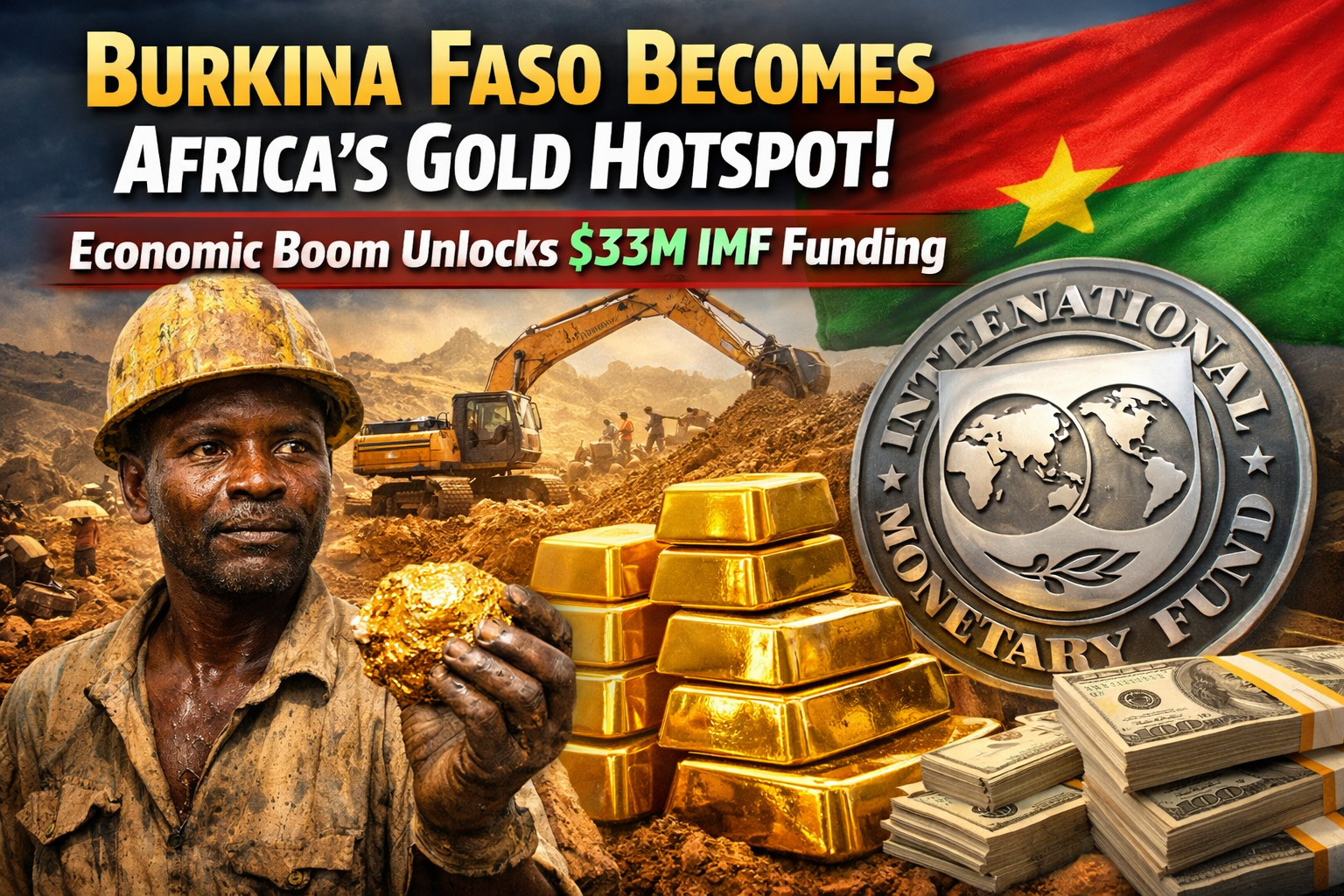
Ouagadougou, Burkina Faso — Burkina Faso Becomes Africa’s Gold Hotspot as Economic Boom Unlocks Fresh $33 Million IMF Funding — a recurring headline across major financial, regional and economic outlets this week — reflects more than just a fiscal boost. It signals a transformative moment for the Sahel nation’s economy, driven by gold, structural reforms, and a strategic engagement with the International Monetary Fund (IMF). The country has navigated a volatile security landscape and resource-driven growth to attract significant international confidence and unlock crucial financial support.
On 18 February 2026, the International Monetary Fund (IMF) completed the fourth review of Burkina Faso’s 48-month Extended Credit Facility (ECF) arrangement and approved an immediate disbursement of about US $33.2 million. The IMF Executive Board simultaneously endorsed a new US $124.3 million Resilience and Sustainability Facility (RSF) to support long-term climate resilience and economic stability through September 2027. This latest funding cements a positive assessment of Burkina Faso’s macroeconomic performance under challenging circumstances and reinforces the view that Burkina Faso Becomes Africa’s Gold Hotspot as Economic Boom Unlocks Fresh $33 Million IMF Funding is much more than a headline — it’s a narrative about reinvention, resource leverage, and strategic reforms.
The Gold Boom That Changed the Game
At the heart of this economic story is gold. Burkina Faso Becomes Africa’s Gold Hotspot as Economic Boom Unlocks Fresh $33 Million IMF Funding in large part because of record-breaking gold output in 2025. Total gold production surged sharply — hitting historic levels of around 94 tonnes, up significantly from previous years thanks to industrial mining expansion, increased artisanal participation, and tighter oversight of production channels.
This remarkable increase has made gold the primary engine of economic growth:
- Gold accounts for the lion’s share of Burkina Faso’s export earnings, contributing over 70 % of export revenues and a substantial proportion of foreign exchange.
- The surge in gold production and higher global gold prices have flipped the country’s current account from a deficit to a projected surplus, strengthening balance-of-payments metrics crucial for IMF assessments.
Mining reforms under the new legal and regulatory framework — including the 2014 revised mining code that increased the government’s free carried interest in major mines — have ensured more revenue remains in the national economy. Government stakes in operations like Essakane and Bomboré, and the pipeline of new projects from companies such as Iamgold, Orezone, and West African Resources, have underpinned investor confidence, even in a volatile operating environment.
Macro Stability Amid Security Challenges
The IMF’s positive review and subsequent fund release under the ECF programme reflects not just mining success but broader economic resilience. Despite enduring ongoing security pressures from militant insurgencies, Burkina Faso has maintained macroeconomic discipline:
- Fiscal deficits have remained within program targets, supported by rising mining revenues and improved domestic revenue mobilisation.
- Inflation has been generally contained, while debt remained on a sustainable path relative to economic output.
- Governance improvements and structural reforms — including public finance management and transparency measures — were highlighted by IMF officials as factors bolstering confidence.
Taken together, these factors have convinced the IMF that Burkina Faso Becomes Africa’s Gold Hotspot as Economic Boom Unlocks Fresh $33 Million IMF Funding was a justified conclusion — i.e., that sufficient structural progress has been made to warrant both continued support and expansion of programmatic facilities.
The IMF’s Dual Approach: ECF + Resilience Support
The fresh US $33.2 million IMF funding comes under the envelope of the Extended Credit Facility — a long-term financing instrument designed to support countries pursuing economic stabilisation and reform. This is significant because the ECF is not simply a loan; it is conditional upon meeting agreed performance criteria, and reflects objective IMF confidence in responsible fiscal plans and execution.
In parallel, the IMF approved approximately US $124.3 million under the Resilience and Sustainability Facility (RSF) — a relatively new mechanism aimed at helping countries build long-term resilience against climate change, food insecurity, and external economic shocks. This dual approval underscores a strategic IMF approach: not just stabilising current finances, but bolstering future economic sustainability.
While the ECF disbursement celebrates short-term macro confidence, the RSF signals trust in the country’s ability to deploy funds in areas critical to long-term growth and livelihoods — including climate-resilient agriculture and public investments that extend beyond extractive industries.
The Human Geography of Mining Growth
The gold renaissance in Burkina Faso has had complex socio-economic implications:
- Formal mining operations alongside artisanal and small-scale mining have created employment, income opportunities, and broader economic linkages.
- The expansion of mining has stimulated local service industries and attracted foreign investment commitments, such as the significant capital allocation by multinational mining firms to maintain or expand extraction capacity.
However, the boom has also brought challenges. Informal artisanal mining still poses environmental and safety risks, while some mines have struggled to meet environmental fund obligations. Government efforts — both regulatory and fiscal — are underway to address these issues, but the path to sustainable, inclusive mining growth remains ongoing.
Policy Shifts and Resource Sovereignty
The combination of resource nationalism and progressive mining legislation has shaped Burkina Faso’s gold decade. Over recent years, the Burkinabé government has pursued policies designed to retain a larger share of mining profits, strengthen local participation, and integrate mining outcomes with broader national development goals. This includes:
- Increasing the government’s stake in major mining operations from 10 % to 15 %, thereby enhancing direct state revenue. (African Leadership Magazine)
- Initiatives aimed at formalising artisanal mining and improving access to credit and technical support for smaller operators.
- Long-term economic plans — such as the recently approved 2026–2030 Recovery Plan — which integrate mining revenues into national infrastructure, security, and human capital investments.
These policy directions reinforce the narrative that Burkina Faso Becomes Africa’s Gold Hotspot as Economic Boom Unlocks Fresh $33 Million IMF Funding — illustrating how resource policy, fiscal discipline, and strategic external engagement can combine to reshape an economy.
The Regional and Global Context
Burkina Faso’s experience stands out regionally, even among fellow resource-rich African states. Gold-dependent economies elsewhere — like Ghana — have also engaged with the IMF and other multilateral lenders, securing significant financing to stabilise macroeconomic indicators without sacrificing growth prospects. Yet Burkina Faso’s progress is notable given the dual pressures of security threats and political transitions.
The IMF’s endorsement of both financial support and structural confidence, as seen in the context of the ECF and RSF, underscores how global financial institutions perceive the interplay between sound policy implementation and resource-driven recovery.
Looking Ahead: Challenges and Opportunities
While Burkina Faso Becomes Africa’s Gold Hotspot as Economic Boom Unlocks Fresh $33 Million IMF Funding captures an inspiring headline moment, it also reflects a transitional phase:
- Sustaining mining growth will require continued investment in infrastructure, environmental stewardship, and skilled human capital.
- Security and governance challenges remain pressing concerns that could affect investor confidence and long-term stability.
- The effective deployment of IMF funds, especially those earmarked for resilience, will be instrumental in diversifying the economic base beyond extractive industries.
In many ways, this inflection point offers lessons for other nations balancing resource wealth with inclusive development agendas. Burkina Faso’s story — of harnessing gold, engaging international partners on terms of reform and resilience, and using IMF support strategically — will likely continue to evolve in the months and years ahead.
Burkina Faso Becomes Africa’s Gold Hotspot as Economic Boom Unlocks Fresh $33 Million IMF Funding
As the world watches closely, Burkina Faso Becomes Africa’s Gold Hotspot as Economic Boom Unlocks Fresh $33 Million IMF Funding isn’t just a repeated headline — it’s a narrative about transformation, resilience, and the strategic use of natural resources to secure a more stable and prosperous future
