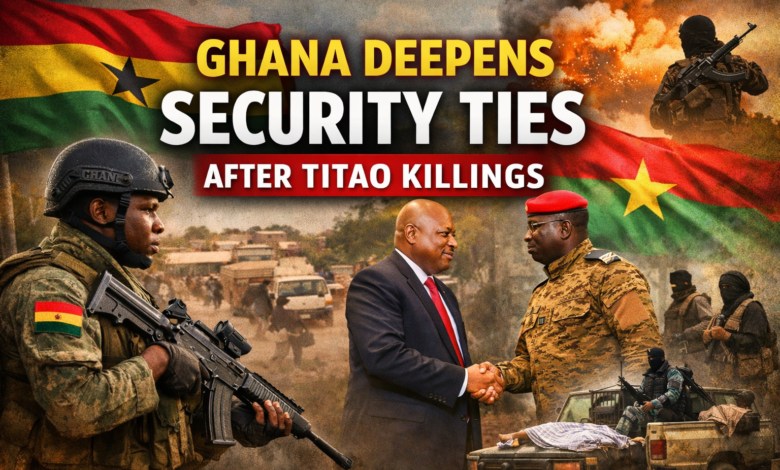
Ghana Deepens Security Ties After Titao Killings. Ghana and Burkina Faso strengthen security cooperation after eight Ghanaian traders were killed in a terrorist attack in Titao. Here’s what the new bilateral agreements mean for border security, trade, and regional stability.
Table of Contents
Tragedy in Titao: Eight Ghanaians Killed in Terror Attack

The Governments of Ghana and Burkina Faso have announced strengthened security cooperation following a deadly terrorist attack in Titao that claimed the lives of eight Ghanaian nationals. Ghana Deepens Security Ties After Titao Killings.
The victims, reportedly tomato traders operating in northern Burkina Faso, were ambushed by armed militants while conducting legitimate cross-border trade. The attack, which occurred on February 14, 2026, has been linked to extremist groups operating in the Sahel region, particularly Jama’at Nasr al-Islam wal Muslimin (JNIM), an Al-Qaeda-affiliated insurgent network active in Burkina Faso and neighboring countries.
The tragic killing of these Ghanaian traders has reignited urgent conversations about border security, terrorism in West Africa, and the protection of civilians engaged in regional trade.
Ghana’s Diplomatic Response and High-Level Engagement

In response to the attack, Ghana’s Minister for Foreign Affairs, Samuel Okudzeto Ablakwa, traveled for high-level discussions with Burkinabè authorities. Ghana Deepens Security Ties After Titao Killings.
The meeting resulted in a renewed commitment between the two nations to:
- Enhance intelligence sharing
- Strengthen joint border patrol operations
- Improve coordinated counter-terrorism strategies
- Establish new bilateral security frameworks
According to officials, both governments agreed that the Sahel’s growing insecurity requires coordinated regional solutions rather than isolated national responses. Ghana Deepens Security Ties After Titao Killings.
Understanding the Sahel Security Crisis
The Sahel region, stretching across West Africa, has experienced escalating violence over the past decade. Militant groups affiliated with Al-Qaeda and ISIS have exploited weak border controls and political instability in countries like Burkina Faso, Mali, and Niger.
The Titao attack highlights three major realities:
- Terrorism is no longer confined within borders.
- Cross-border traders and transporters are increasingly vulnerable.
- Regional economic integration depends on security cooperation.
Northern Burkina Faso has become one of the epicenters of extremist activity, with frequent attacks targeting civilians, traders, and security forces.
New Ghana–Burkina Faso Security Framework: What It Includes
Following diplomatic engagements, Ghana and Burkina Faso are reportedly working on a comprehensive security framework designed to improve:
1. Intelligence Coordination
Real-time sharing of threat intelligence between security agencies.
2. Joint Border Surveillance
Coordinated patrols along the Ghana–Burkina Faso frontier to prevent militant infiltration.
3. Counter-Terrorism Operations
Structured operational collaboration to dismantle extremist networks.
4. Trade Protection Measures
Security protocols to protect traders, transport unions, and cross-border commercial activities.
These measures are expected to reduce vulnerabilities and prevent future tragedies involving Ghanaian citizens operating outside the country.
Economic and Trade Implications for Ghana
Cross-border trade between Ghana and Burkina Faso plays a critical role in:
- Tomato and agricultural supply chains
- Livestock trade
- Transportation and logistics services
- Informal sector employment
The attack has sparked concern among Ghanaian traders, transport unions, and agricultural stakeholders who depend heavily on northern trade routes.
Security analysts warn that prolonged instability could disrupt food supply chains and increase commodity prices in Ghana’s markets.
ECOWAS and Regional Security Coordination

The regional bloc, ECOWAS, has condemned the killings and called for a thorough investigation.
ECOWAS continues to emphasize collective security approaches, particularly as Sahel instability threatens coastal West African nations, including Ghana, Côte d’Ivoire, and Togo.
Security experts believe stronger regional cooperation will be critical in preventing extremist expansion toward coastal states.
A Wake-Up Call for Ghana’s National Security Architecture
The Titao attack serves as a sobering reminder that Ghana, though relatively stable, is not immune to the ripple effects of Sahel terrorism.
Key national security considerations now include:
- Strengthening northern border infrastructure
- Expanding military and intelligence capabilities
- Supporting community-level vigilance systems
- Increasing diplomatic engagement with Sahel neighbors
Ghana’s proactive diplomatic response demonstrates recognition that prevention is more effective than reaction.
The Human Cost Behind the Headlines
Beyond geopolitics and security strategies lies the painful human toll. Eight Ghanaian families have lost loved ones who were simply working to earn a living.
The tragedy underscores the urgent need to protect civilians engaged in lawful commerce and to ensure that economic survival does not come at the cost of life.
A Turning Point in Ghana–Burkina Faso Relations
The Titao massacre may mark a defining moment in Ghana–Burkina Faso relations. While the attack exposed security vulnerabilities, it has also accelerated deeper diplomatic and military collaboration.
If effectively implemented, the new security framework could:
- Strengthen border protection
- Safeguard regional trade
- Deter extremist activity
- Promote long-term West African stability
For Ghana, this is not merely a foreign policy issue — it is a matter of national security, economic stability, and human protection.