




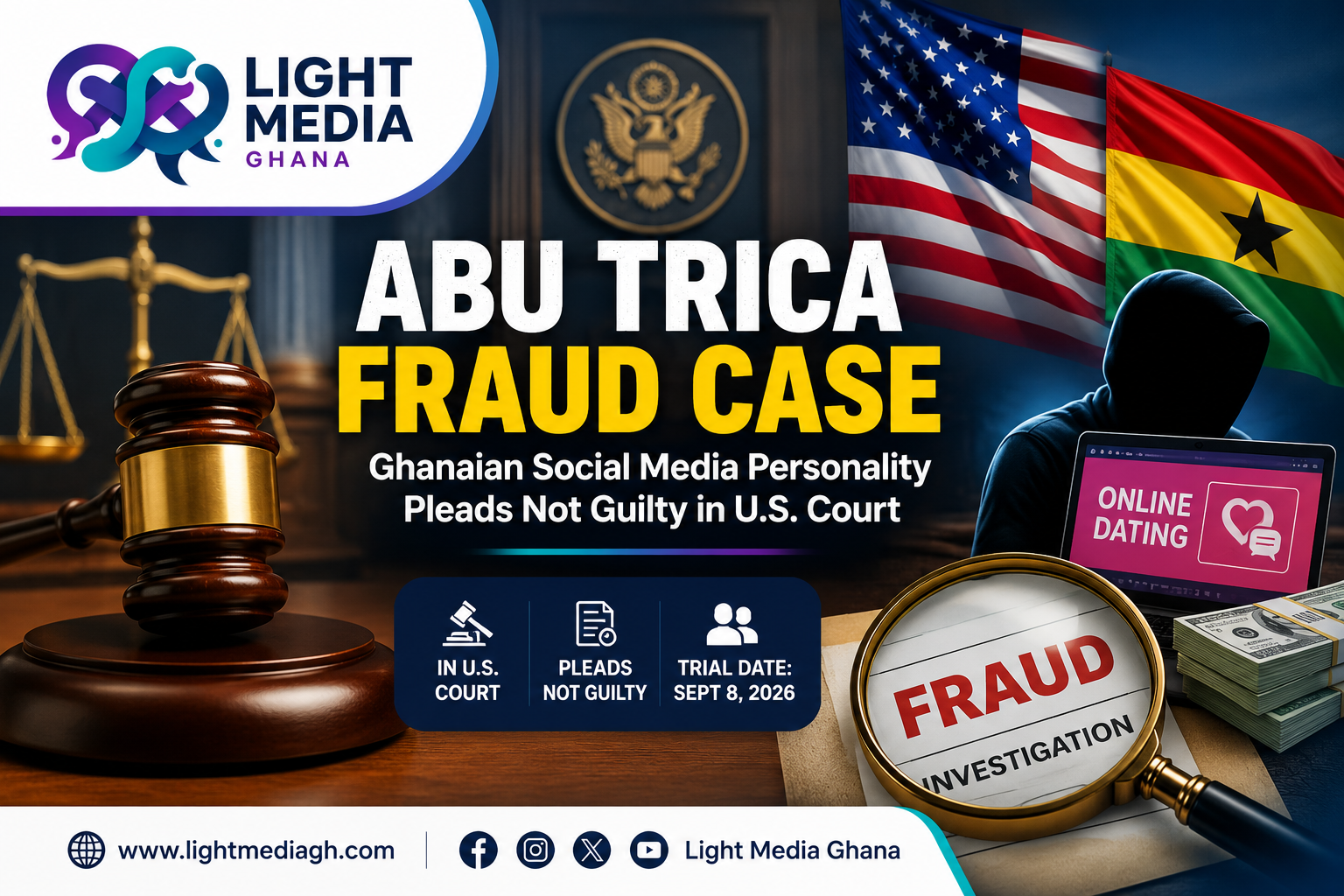
The Abu Trica fraud case has taken a new turn as the Ghanaian social media personality pleads not guilty in a U.S. court after being extradited over an alleged $8 million romance scam.
The Abu Trica fraud case has entered a new phase after Ghanaian social media personality Frederick Kumi, popularly known as Abu Trica, appeared before a United States federal court and pleaded not guilty to multiple fraud-related charges.
The case has attracted widespread attention in Ghana and beyond following his extradition to the United States, where prosecutors allege he was part of an international romance scam network that defrauded dozens of elderly victims of more than $8 million. While the allegations are serious, it is important to note that Abu Trica has denied the charges, and under U.S. law, he is presumed innocent unless proven guilty in court.
Abu Trica Fraud Case Reaches U.S. Federal Court
According to the U.S. Department of Justice, Abu Trica was extradited from Ghana to the United States on July 14, 2026, to face charges relating to an alleged international romance fraud operation.
Federal prosecutors claim the alleged scheme targeted elderly victims across the United States by using fake online identities on dating websites and social media platforms. The victims were allegedly persuaded to send money after developing what they believed were genuine romantic relationships.
Following his arrival in the United States, Abu Trica made his initial appearance before a federal judge, where he entered a not guilty plea to all charges.
If convicted, he could face significant prison time under U.S. federal sentencing laws.
What Are the Charges Against Abu Trica?
The Abu Trica fraud case involves two primary federal charges:
1. Conspiracy to Commit Wire Fraud
Prosecutors allege that members of the alleged criminal network used electronic communications, including emails, text messages, and online platforms, to deceive victims into transferring money.
Wire fraud is one of the most commonly prosecuted financial crimes in the United States, particularly in cases involving online scams.
2. Money Laundering Conspiracy
The second charge alleges that proceeds from the alleged fraud were transferred through various financial channels to conceal the origin of the funds.
Investigators claim the money moved through multiple accounts as part of the alleged operation.
At this stage, these remain allegations that prosecutors must prove in court.
Prosecutors Allege an $8 Million Romance Scam
According to court documents, investigators believe the alleged fraud scheme operated over several years.
The U.S. Department of Justice alleges that:
- More than 80 elderly victims were affected.
- Victims collectively lost over $8 million.
- Fake online identities were allegedly created to build trust.
- Some identities reportedly used advanced technology, including AI-assisted content, to communicate with victims.
Authorities say victims believed they were helping romantic partners facing emergencies, business difficulties, or travel-related problems.
Once trust had been established, victims allegedly transferred large sums of money.
Abu Trica Maintains His Innocence
Despite the allegations, Abu Trica has denied any wrongdoing.
During his first court appearance in the United States, he pleaded not guilty, meaning the case will proceed through the American judicial system.
A not guilty plea does not determine innocence or guilt. Instead, it requires prosecutors to present evidence during trial while giving the defendant the opportunity to challenge that evidence.
Legal experts note that every accused person is entitled to a fair trial and is presumed innocent unless found guilty by a court.
Trial Date Set
Following the initial hearing, the federal court scheduled September 8, 2026, as the tentative date for jury trial proceedings.
Between now and the trial, both prosecutors and defense lawyers are expected to exchange evidence, file legal motions, and prepare witnesses.
Additional court hearings may also take place before the trial officially begins.
Public Reaction in Ghana
News of the extradition has generated significant discussion across Ghana, particularly on social media.
Many users have expressed surprise at the developments, while others have called for patience until the legal process concludes.
Legal analysts have also reminded the public that allegations reported by prosecutors should not be treated as proof of guilt.
The case has also renewed conversations about online fraud, cybercrime, and the dangers of romance scams targeting vulnerable individuals around the world.
Understanding Romance Scams
Romance scams have become one of the fastest-growing forms of online fraud globally.
Criminals typically create fake profiles on dating websites or social media platforms before developing emotional relationships with victims.
After gaining trust, they often request money for medical emergencies, business investments, travel expenses, or family crises.
Authorities advise internet users to:
- Avoid sending money to someone they have never met in person.
- Verify identities before entering financial arrangements.
- Be cautious of requests involving urgent financial assistance.
- Report suspicious online activity to law enforcement.
What Happens Next?
The Abu Trica fraud case will now move through the U.S. federal court system.
During the trial, prosecutors will attempt to prove the allegations beyond a reasonable doubt, while the defense will challenge the government’s evidence.
Until a verdict is reached, Abu Trica remains legally presumed innocent.
The outcome of the case will be closely followed in both Ghana and the United States due to its international nature and the seriousness of the allegations.
Conclusion
The Abu Trica fraud case has become one of the most widely discussed legal matters involving a Ghanaian citizen in recent months.
His extradition to the United States and subsequent not guilty plea mark only the beginning of what could be a lengthy legal process.
As the trial date approaches, more information is expected to emerge through official court proceedings. Until then, it is important to rely on verified information and remember that the charges remain allegations that must be tested in court.
Light Media Ghana will continue to monitor the proceedings and provide factual updates as they become available.
Frequently Asked Questions (FAQs)
Who is Abu Trica?
Abu Trica, whose real name is Frederick Kumi, is a Ghanaian social media personality currently facing fraud-related charges in the United States.
What is the Abu Trica fraud case about?
The case involves allegations that Abu Trica participated in an international romance scam that allegedly defrauded more than 80 elderly victims of over $8 million.
Has Abu Trica been convicted?
No. Abu Trica has pleaded not guilty, and no conviction has been made. He remains presumed innocent unless proven guilty in court.
When is Abu Trica’s trial?
According to U.S. court proceedings, the jury trial is scheduled to begin on September 8, 2026, unless the court changes the date.
